


Key Takeaways
- A basketball court has about ten distinct lines and markings, each with its own name and purpose.
- The boundary lines are the baseline and sidelines; cross them with the ball and it’s out of bounds.
- The key (or “paint”) is the painted lane under each hoop where the three-second rule applies.
- The three-point line’s distance changes by level of play, but its role — marking 3-point shots — stays the same.
- The names and purpose of the lines are the same everywhere; only the court size and a few distances change.
Every basketball court — from a backyard half-court to an NBA arena — shares the same set of lines. There are around ten of them, and each one either marks a boundary or enforces a rule. This guide explains what every line is called and what it does, so you can read any court at a glance. For exact court dimensions by level of play, see our dimensions guides.
The Lines on a Basketball Court, Explained
Basketball wooden court sport game top view vector illustration graphic design:
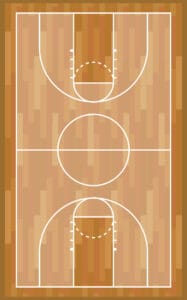
1. Baseline (end line)
The boundary line running behind each hoop, along the short ends of the court. Step on or over it with the ball and it’s out of bounds. It also anchors inbound plays after a basket.
2. Sideline
The two long boundary lines down each side of the court. Together with the baselines they define the in-bounds playing area.
3. Center line (half-court line)
Divides the court into two equal halves. Once the offense crosses it, they can’t take the ball back over it — the “backcourt” violation.
4. Center circle
The circle at midcourt where the game starts with the opening tip-off. Usually about 12 feet across.
5. The key (paint / free-throw lane)
The painted rectangle extending from the baseline to the free-throw line under each hoop. It governs the three-second rule and is where most of the scoring happens — hence “in the paint.”
6. Free-throw line (foul line)
The line at the top of the key, 15 feet from the backboard, where players shoot uncontested foul shots. Standard at every level of play.
7. Free-throw circle
The circle centered on the free-throw line. The top half is used for jump balls and to position players during free throws.
8. Three-point line (arc)
The long arc around each hoop. Shots made from behind it are worth three points; inside it, two. Its distance from the basket changes by level of play (high school, college, NBA). See our school basketball court guide for the exact distances.
9. Restricted area (no-charge arc)
The small arc directly under the basket. A defender inside it can’t draw a charging foul — it protects players driving to the rim.
10. Lane (hash) marks
The short marks along the sides of the key where players line up during free throws, spaced to keep positioning fair.
Why Accurate Court Striping Matters
Lines aren’t just paint — they define the game. Faded, uneven or incorrectly spaced markings cause bad calls and make a court look neglected. Professional striping uses the correct measurements and durable court paint so the lines stay crisp for years, even in Florida sun. If you’re building or refreshing a court, our basketball court construction team handles layout and striping to spec.
Basketball Court Lines FAQ
What are the lines on a basketball court called?
The main lines are the baseline, sidelines, center line, the key (or paint), the free-throw line, the three-point line and the restricted-area arc. Each defines a boundary or a rule of play.
What is the painted area on a basketball court called?
It’s called the key, the paint, or the free-throw lane. It runs from the baseline to the free-throw line under each hoop and governs the three-second rule.
How far is the three-point line?
It depends on the level of play. The distance from the basket is shorter for high school, longer for college, and longest in the NBA. See our school basketball court guide for the exact figures.
What is the restricted area under the hoop?
It’s the small arc beneath the basket, also called the no-charge zone. A defender standing inside it cannot draw a charging foul, which protects players driving to the rim.
Do basketball court lines differ by level of play?
Yes. The court’s outer size and the three-point distance and key width change between high school, college and professional courts, but the names and purpose of the lines stay the same.
Building or Refreshing a Basketball Court?
Sport Surfaces has built, resurfaced and striped courts across Florida since 1998. Explore our basketball court construction service, or request a free estimate today.