
Choosing a new running track is a decision that impacts athletes and budgets for decades to come, especially when selecting the right polyurethane track material from the available sports surface materials. But with terms like ‘full-pour’ and ‘sandwich system’ being thrown around, how do you know you’re making the right choice? This polyurethane track material comparison guide explains the options in plain English and helps you match the right surface to your specific goals.
That familiar red surface is far more than just rubber and paint; it’s an engineered system. Engineers carefully design each layer to balance performance and safety, creating a specific feel underfoot. This is why an Olympic track built for speed feels so different from a community track designed for comfort. The running track construction creates a crucial trade-off between a “fast” surface that returns energy and a “forgiving” one that absorbs impact.
This guide demystifies these systems, detailing the three primary types of polyurethane tracks and how each performs on cost, lifespan, and athlete experience. The goal is to provide the clarity needed to select the best surface, ensuring your investment serves your community for years to come with guidance from experienced sports surface specialists.
More Than Just a Surface: How Your Track’s Material Impacts Speed and Safety
Ever notice how some running tracks feel soft and forgiving, while others feel firm and incredibly fast? That difference isn’t your imagination; it’s a deliberate engineering choice. Engineers design every polyurethane track surface to balance two competing goals: protecting the athlete’s body and maximizing speed. Understanding this trade-off is the first step in choosing the right surface for your facility’s needs, whether that’s for daily physical education or for hosting championship meets.
Consider running on a beach. Running on soft, dry sand is gentle on your joints because the sand absorbs the impact. This is called Force Reduction, or shock absorption. Now, imagine running on the firm, damp sand near the water, which feels springy and lets you run faster. This is Energy Return—the surface “gives back” some of the force you put into it, propelling you forward. A high-cushion track offers great force reduction, while a high-performance track delivers exceptional energy return.
Ultimately, no single track can be the absolute best at both. A surface optimized for the safety and comfort of daily training (high force reduction) will naturally feel “slower” than one tuned for elite competition (high energy return). The different track systems are essentially unique “recipes,” each mixed to achieve a specific point on the spectrum between safety and speed.

The 3 Main Polyurethane Track Material Systems
The way contractors combine polyurethane and rubber on-site determines the balance between safety and speed. While the core ingredients are similar, there are three primary “recipes” for building a modern track, each delivering a different result in terms of cost, durability, and performance feel.
You can think of these systems on a spectrum from good to best, much like car models. On one end is the economical Spray-Coat System, a durable workhorse for many high schools. On the other is the elite Full-Pour System, the surface of choice for Olympic stadiums. In the middle, the Sandwich System offers a popular ‘best-of-both-worlds’ approach, balancing high performance with value.
Each system features a unique construction of its cushioned base and durable top wear-layer, which directly impacts its lifespan and athletic feel. We’ll start with the choice of champions: the Full-Pour System.
The Full-Pour System: Why Olympic Tracks Feel So Fast
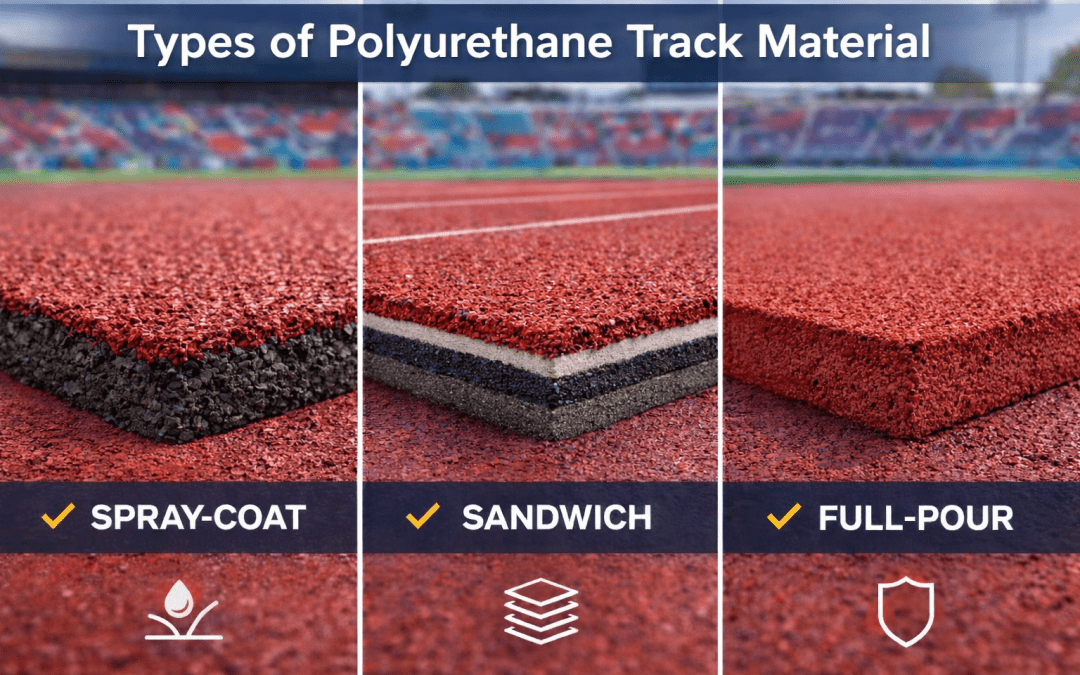
The Full-Pour System represents the highest-performance polyurethane track material, and its secret lies in its construction. Instead of using pre-made components, contractors mix and pour every layer as a liquid on-site. This poured-in-place process creates a completely seamless surface—a single, unified slab with no joints or weak points. Much like a seamless countertop is more durable than one made of tiles, this surface offers unmatched consistency across every lane.
This unique construction is what makes a full-pour track the best running track surface for performance. The liquid-poured layers are tuned for maximum energy return, giving athletes that “fast” feeling underfoot. Its uniformity and durability are why the system can achieve World Athletics (IAAF) certification, a requirement for hosting Olympic-level events. It’s the surface built for breaking records.
Naturally, this level of performance comes at a premium. The full-pour system is the most expensive option, typically reserved for elite university programs and professional stadiums. But what if your facility needs a championship-caliber feel without an Olympic-sized budget? For many, the answer lies in a popular “best-of-both-worlds” approach.
The Sandwich System: Balancing Top-Tier Performance with Your Budget
If a full-pour track is the custom-built sports car, the Sandwich System is the high-performance sedan. It gives you an exhilarating ride without the racetrack-only price tag. Its name perfectly describes the construction: it isn’t poured entirely from scratch. Instead, contractors build the system in layers, starting with a separate, shock-absorbing foundation that provides the all-important cushion for athletes.
The process begins with a prefabricated base mat—a thick layer of machine-made rubber that provides excellent shock absorption. This foundational cushion is then sealed and topped with a high-performance, liquid-poured layer of polyurethane and fine rubber granules. This delivers the same seamless, durable running surface found on the most elite tracks, giving athletes exceptional grip and energy return where it matters most—right under their feet.

This combination creates a brilliant compromise. You get the world-class durability and performance feel of a poured top surface with the significant cost savings of a pre-made base. It’s the go-to option for competitive high schools and universities that host major events but need to work within a responsible budget. But for many facilities, even this is more performance than needed. What about a surface designed for everyday durability?
The Spray-Coat System: The Smart, Durable Choice for Most Schools
For many facilities, the top priority isn’t hosting the Olympics—it’s providing a safe, dependable surface that can stand up to daily physical education classes, team practices, and community use. This is where the Spray-Coat System shines. As the most common type of running track material installed worldwide, it is the undisputed workhorse for schools and parks, starting with a paved base of black rubber granules bound with polyurethane.
The single most important feature of this system is that it’s porous. Unlike the solid, sealed surfaces of its high-performance cousins, a spray-coat track is designed like a firm sponge. Rainwater drains directly through the surface instead of pooling on top. This simple difference makes it a fantastic all-weather running track solution, drastically reducing downtime after a storm and keeping your facility operational. A thin, structural spray of colored polyurethane provides the durable, textured finish.
While it may not provide the same elite energy return as a sandwich or full-pour system, the spray-coat track delivers the best overall value for most organizations. It offers an excellent balance of durability, safety, and a significantly lower upfront cost, making it the go-to choice for those prioritizing multi-use functionality and long-term value over pure speed.
The Bottom Line: Cost, Lifespan, and Performance Compared
Making the right choice in polyurethane track material comes down to balancing your budget, performance goals, and long-term plans. To simplify the decision, here is a direct running track breakdown that compares our three polyurethane systems on the factors that matter most to facility owners and athletes.
- Spray-Coat System (The Workhorse)
- Lifespan Before Resurfacing: 7-10 years
- Performance Feel: Forgiving and comfortable for daily training.
- Best For: High schools, public parks, and multi-use facilities.
- Sandwich System (The All-Star)
- Lifespan Before Resurfacing: 10-15 years
- Performance Feel: A fast, responsive surface with excellent shock absorption.
- Best For: Universities and competitive high school programs.
- Full-Pour System (The Olympian)
- Lifespan Before Resurfacing: 15+ years
- Performance Feel: Elite speed and maximum energy return.
- Best For: Division I universities and professional stadiums hosting championships.
While upfront cost is a major factor, the key is understanding a track’s lifespan and how surface damage is managed over time, including the use of proven crack repair systems for asphalt courts. A more expensive system like a Full-Pour track may actually be more economical over 20-30 years because it requires fewer resurfacing cycles. This concept, known as Total Cost of Ownership, is critical for making a sustainable investment.
How to Choose the Right Polyurethane Track for Your Facility
Understanding the engineered systems behind a running track’s surface is the key to making a smart investment. With a clear map connecting materials to outcomes, you can move beyond confusing terms and focus on what matters for your budget, athletes, and facility.
The process of choosing a running track surface material begins with one question: Is its primary purpose daily training or hosting major competitions? Your answer is the key. Use this simple guide to find your match:
- Choose a Spray-Coat if your priorities are value, durability for daily use, and all-weather access.
- Choose a Sandwich System if you need a certified, high-performance surface for competition but must balance cost and performance.
- Choose a Full-Pour System if your primary goal is elite, record-breaking performance and budget is a secondary concern.
This clarity prepares you to lead an intelligent conversation with vendors and justify your choice to stakeholders. By selecting the right surface, you make a strategic investment that serves your community for decades.