

Takeaways
- Surface selection is a long-term infrastructure decision, not simply a matter of player preference.
- Hard courts and clay have different cost structures: hard courts typically cost less upfront but require periodic resurfacing, while clay requires ongoing grooming and maintenance.
- Player demographics matter. Clay can support sliding, reduce braking impact, and appeal to performance-focused and older players, while hard courts offer flexibility for high-traffic and multi-sport facilities.
- Florida’s climate changes the equation. Heat, rainfall, drainage, soil conditions, and water availability should all factor into surface selection.
The Strategic Choice: Beyond the Baseline in 2026
A tennis court is not a purchase; it is an infrastructure commitment. The surface selected today will dictate labor schedules, water usage, insurance exposure, and player retention for the next two decades. Most owners approach the clay vs hard court question as a matter of taste — what the head pro likes, what the board members grew up on. That framing leads to underused asphalt slabs and clay courts nobody budgeted to groom.
The better approach treats surface selection as a capital planning exercise with three fixed pillars:
- Cost structure. Not just the build number, but the shape of the spending curve — a low entry price with periodic resurfacing events, versus a higher entry price with steady, predictable daily labor. Understanding hard court vs clay court maintenance can significantly impact your long-term budget.
- Playability and population fit. Who actually books court time? High-performance juniors, weekend doubles groups, and members in their sixties and seventies want fundamentally different things from a surface. Comparing tennis court surfaces can help identify the best fit for your players.
- Longevity and failure modes. Every surface degrades. What matters is whether it fails gradually and repairably or suddenly and expensively.
The conversation around facilities in 2026 has also broadened. Multi-generational use, pickleball overlay demand, and rising expectations around joint safety have all moved surface choice out of the pro shop and into the finance committee. Evaluating clay vs hard court options is crucial in making informed decisions.
The Physics of Play: How Surface Geometry Dictates Style
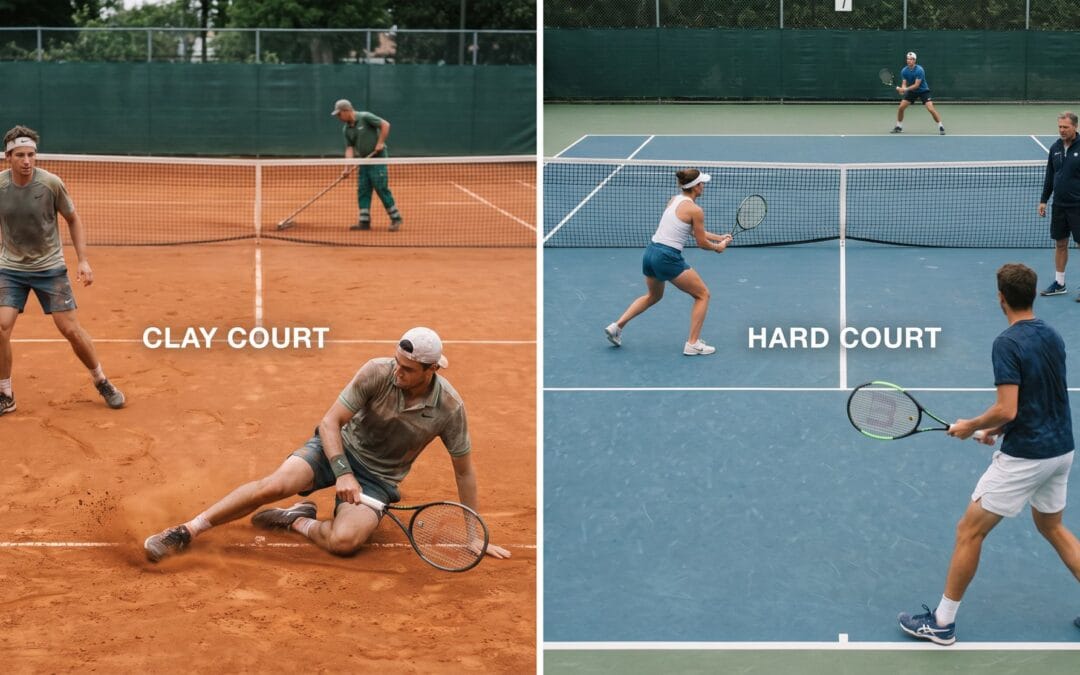
Surface behavior comes down to two variables: how much energy the court returns to the ball, and how much friction it applies to the player’s shoe. A hard court — asphalt or concrete under an acrylic system — is rigid and returns energy efficiently. The ball skids through low and fast, rewarding flat serves, early strike points, and first-strike aggression. Points end sooner. Big servers thrive.
Clay absorbs energy and applies drag. The ball digs into the loose top dressing, slows, and kicks upward. Rally length increases, angles matter more than raw pace, and heavy topspin becomes a genuine weapon rather than a stylistic choice.
Quick Specs
| Hard Court | Clay Court | |
|---|---|---|
| Ball speed | Fast, low skid | Slowed, energy absorbed |
| Bounce height | Moderate and predictable | Higher, more variable |
| Footing | Grip and stop | Slide and recover |
| Point length | Shorter | Extended |
This is why players often find clay courts more challenging. Clay demands sliding footwork, patience, and shot construction, and it punishes players who only know how to hit through the ball. That learning curve is precisely why development programs value it.
Impact and Longevity: The Case for Joint Health
The mechanical differences between surfaces impact the body. On a hard court, a player decelerating from a wide ball stops abruptly. The shoe grips, momentum does not dissipate, and the load transfers up through the ankle, knee, hip, and lower back. Repeated thousands of times per season, that shock accumulates.
Clay changes the deceleration curve. The loose granular top layer lets the foot slide two to three feet into the shot, spreading braking force over time instead of concentrating it in a single impact. The court gives, so the joint does not have to.
For any facility serving members past their mid-forties, joint protection is not a comfort feature — it is a retention strategy. Players who can compete without pain keep renewing memberships.
Demographic considerations are crucial here. A high school program with resilient teenage athletes may never feel the difference. A private club with a large cohort of longtime members will feel it immediately, which is why Har-Tru and similar granular systems dominate established clubs across the Southeast. Court time booked is the real metric, and comfortable surfaces get booked.
The Maintenance Reality: Daily Grooming vs. Long-Term Resurfacing
Understanding the maintenance of hard courts versus clay courts involves recognizing that both surfaces incur costs — they are just billed differently. Hard courts defer their expense; clay courts distribute it.
| Hard Court | Clay Court | |
|---|---|---|
| Daily tasks | Sweep debris, clear standing water, inspect net line | Drag or broom the full surface, line sweep, water to maintain moisture, monitor top dressing depth |
| Weekly to monthly | Spot-clean mildew, check for hairline cracking | Roll the surface, redistribute material to worn zones, clean lines |
| Multi-year capital requirements | Crack repair, patching, full acrylic resurfacing on a recurring cycle; structural cracking may require reconstruction | Periodic top dressing replenishment, laser grading, irrigation servicing; base rarely fails outright |
The critical distinction is failure mode. When a hard court’s base moves — and in Florida soils it moves — cracking propagates and repairs become cosmetic patches on a structural problem. Clay wears rather than breaks, and worn clay is refilled, not replaced. Comparing hard court vs clay court maintenance can provide valuable insights into the expected lifecycle of your investment.
Sub-irrigated clay systems have significantly reshaped this calculation. By feeding moisture up from beneath the surface rather than relying on overhead watering, they cut daily labor hours, stabilize playing conditions through dry spells, and remove the guesswork from moisture management.
Environmental and Regional Suitability in Florida
Climate should carry real weight in any evaluation of tennis court surfaces compared for a Florida site. Two local realities dominate: surface temperature and water volume.
Dark acrylic surfaces over asphalt absorb and retain heat. By mid-afternoon in July, a hard court can become genuinely punishing, pushing play into narrow early-morning and evening windows and effectively reducing the usable hours of a substantial capital asset. Clay, kept moist, runs meaningfully cooler and stays playable deeper into the day.
Then there is rain. A hard court is non-porous by design — water must travel across the surface to perimeter drainage, and any settlement or birdbath holds puddles long after the storm clears. A properly built clay court is porous. Water moves down through the top dressing and base, and courts frequently return to play within a short window after a downpour. Har-Tru’s granular structure also performs reliably in sustained humidity, where sealed acrylic can encourage mildew and algae.
Pro Tip: In Florida, drainage design outranks surface selection. Sandy soils, high water tables, and intense seasonal rainfall mean the base and perimeter drainage engineering determine whether either surface reaches its expected service life.
Cost Analysis: Initial Investment vs. Total Cost of Ownership
Any credible tennis court surface guide 2026 has to separate construction cost from ownership cost, because they rank in opposite directions.
Initial capital outlay
- Asphalt or post-tensioned concrete with an acrylic color system carries the lower entry cost and the shorter construction timeline.
- Sub-irrigated clay costs more upfront. The premium buys subsurface irrigation, reservoir plumbing, and precision grading — engineering, not just material.
Recurring operational budget
- Hard courts require minimal daily labor but demand reserve funding for resurfacing cycles and crack remediation.
- Clay requires dedicated grooming labor and annual top dressing, plus capital equipment: rollers, drag brooms, line sweepers, and moisture monitoring.
Asset positioning
- Clay courts signal a premium facility. In residential settings they read as an amenity rather than a slab, and in club settings they support higher dues structures.
- Hard courts offer conversion flexibility, including pickleball striping and dedicated overlay — a decisive factor for municipalities balancing programming demand across sports.
Professional tennis court construction should be scoped around the total cost of ownership over twenty years, because the real return comes from courts that stay booked, not courts that were cheap to pour.
Conclusion: Selecting the Surface for Your Legacy
The right answer depends on who plays and who pays. Municipal facilities and school programs, with high traffic, mixed sports demand, and constrained maintenance staffing, are generally best served by hard courts — durable, flexible, and easy to convert for pickleball. Private clubs and high-end residential properties with an aging or performance-focused membership get more value from clay, where joint protection and playing experience translate directly into retention and property appeal. Larger facilities often find the honest answer is both, with clay courts serving members and hard courts absorbing programming volume.
What should never happen is committing to a surface before the site has been evaluated. Soil composition, water table depth, grade, sun orientation, and available maintenance labor change the calculation more than any general comparison can. While a general contractor may build the slab, a specialized court builder engineers the base, drainage, and surface system as an integrated asset with a twenty-year horizon.
Sport Surfaces builds and maintains athletic surfaces across Florida, leveraging the drainage and base engineering expertise demanded by this climate. Request a custom site evaluation before breaking ground — it’s far easier to make the right decision upfront than to correct it later.
FAQs
1. What is the main difference between clay and hard tennis courts?
Hard courts provide a faster, lower bounce that favors aggressive play, while clay slows the ball, produces a higher bounce, and supports longer rallies and more strategic play.
2. Which tennis court surface is easier to maintain?
Hard courts require less daily maintenance but need periodic crack repairs and resurfacing. Clay requires regular grooming, watering, and top dressing but can be repaired and replenished without replacing the entire surface.
3. Are clay courts better for joint health?
Clay can reduce the impact of sudden stops by allowing players to slide during deceleration, potentially reducing concentrated braking forces compared with rigid hard courts.
4. How should a facility choose between a clay and hard tennis court?
The decision should consider player demographics, maintenance resources, climate, drainage, site conditions, construction costs, and long-term total cost of ownership rather than player preference alone.